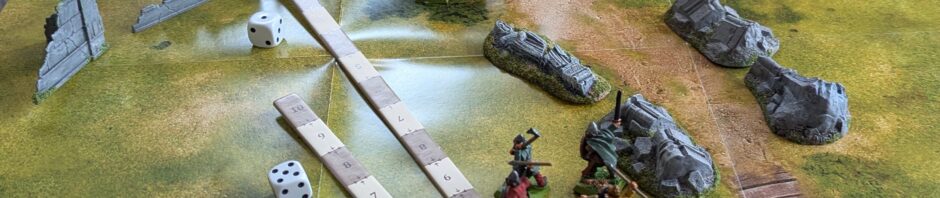
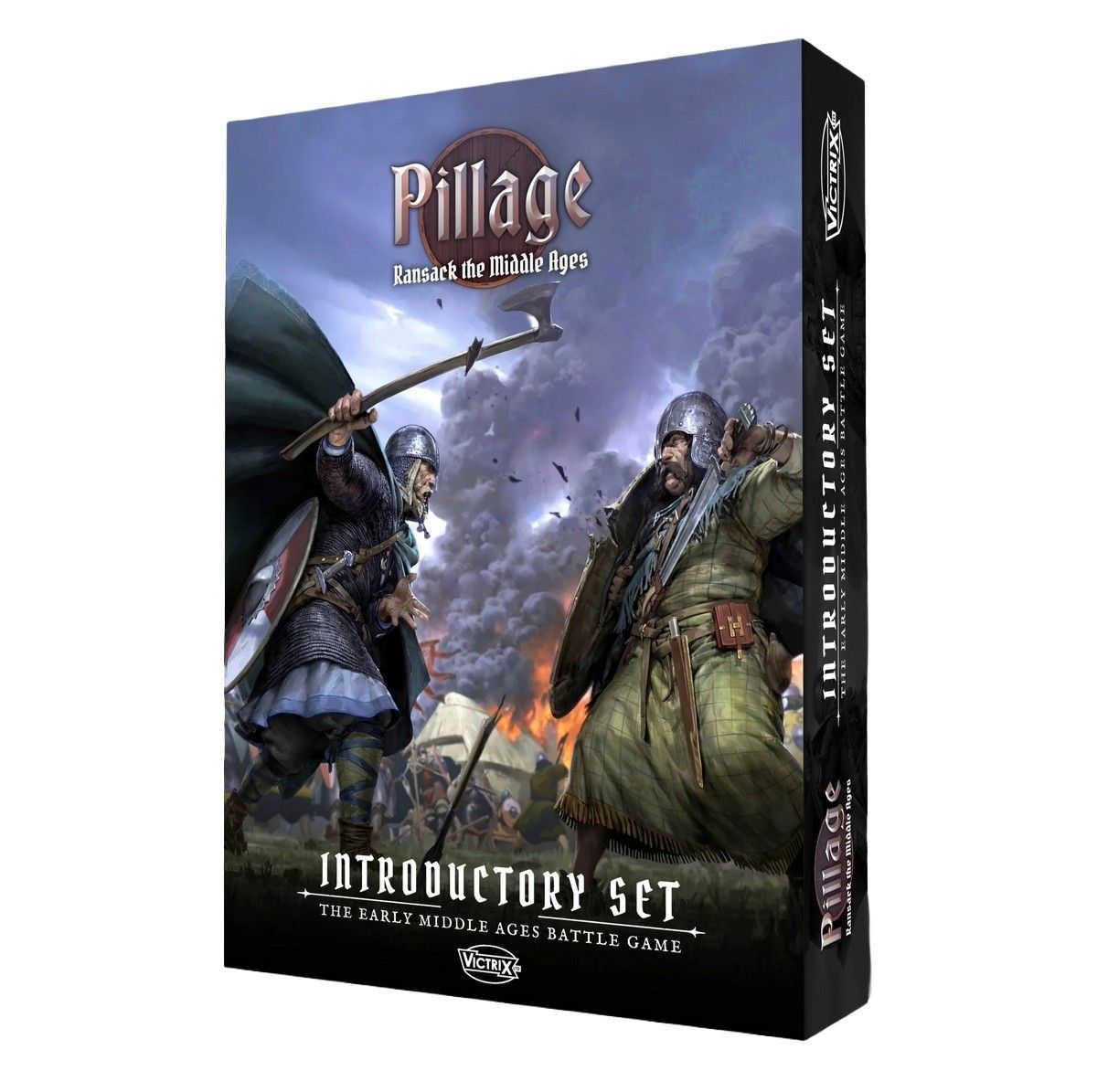
 I got a recent introductory set for Pillage, a Dark Ages/Early Medieval skirmish wargame of raiding and loot stealing. t is a decent set, with rules to teach you the basics, a sprue of Irish warriors, a sprue of Irish warriors, a small house to build, some fences, a sprue of lootable animals and goods, a card sheet with some tokens and a ruler, some 6 sided dice and a double sided paper playmat.
I did not have time to build and paint them all, but I used some old Viking and Hiberno-Norse figures I had, a cardboard house, some Lord of the Rings ruins and the Pillage playmat to try the rules out with one of the included scenarios. The Viking raiders enter at one side of the map, have to head to the house and set it ablaze.
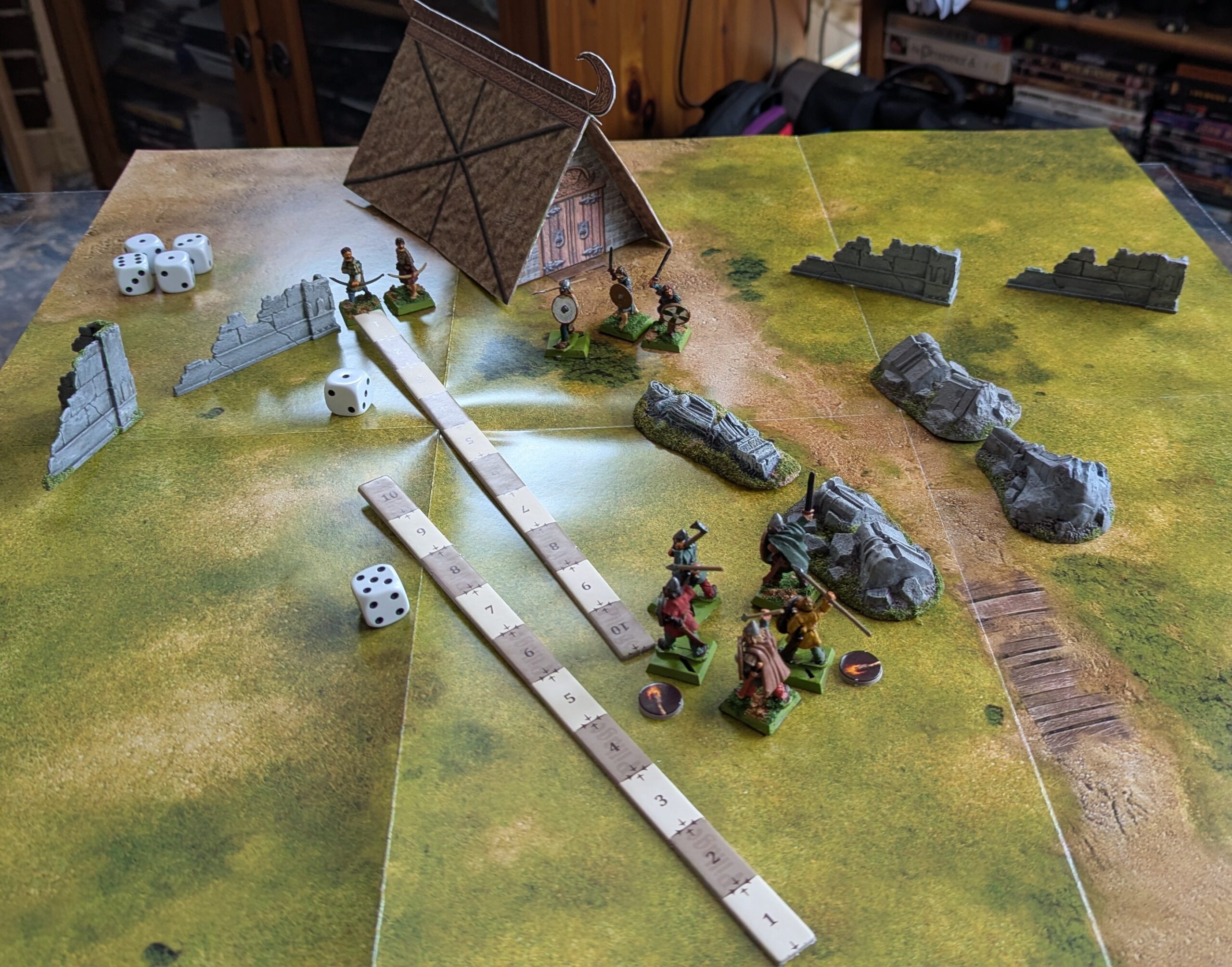
The vikings get closer. To at the back carry torches to fire the house, the card rulers and mat are from the Pillage Introductory set
I liked the rules, they were fast, simple, but I could see the otential for using them as is, and adapting it to fantasy skirmish as well.
The playmat size was particularly inspiring. In this space I could have some useful games in timers when setting up for larger battles, which involves setting up on the floor, was impractical.
Hoever, there are reasons I do not want to get the current edition of the full rules, so what else could scratch that same itch? I asked on Bluesky and got a decent list of other Skirmish rules that might do for this space and handful of figures a side, so I decided to have a try of the more popular and interesting recommendations.
One Hour Ancient & Medieval Slirmish Wargames
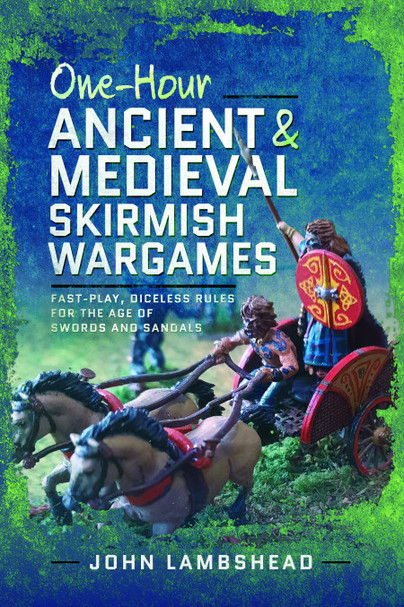 The first game I wanted to try is “One Hour Ancient and Medieval Skirmish Wargames” by John Lambshead, published by Pen & Sword Books, as it is one of the rules I already had.
Instead of dice, this system uses decks of normal playing cards, the normal 52 cards and one joker. Each side has their own deck and cards are drawn for determining initiative, how many actions you have, and resolving combat. Each side, in initiative order, draws a card for number of actions, performs those actions and then the other player takes their turn.
If the Joker is drawn, no matter what is happening, the turn ends and you tidy up housekeeping, seeing which wounded figures are, in fact, dead, and checking morale. Forces have an inherent morale which, added to a card draw, is compared to the casualties. As long as it is higher, forces will stick around. .
A human is a human is a human. Extra skills and special features can be bought for special figures, but movement and number of attacks and defence are a feature of the gear the figure carries. How extra attacks and defences are modeled is simply by increasing the number of cards you draw, but, in a contest of cards, only the highest card matters, more cards just gives you more chance to draw a high card. A side-effect to going through your deck faster is, of course that you will reach the end of the turn more often, which may, or may not, suit you at that time.
I played the scenario twice, over two nights, the second being particularly useful as naturally I forgot fewer of the rules second time around, not that the rules are complex or too numerous.
The scenario
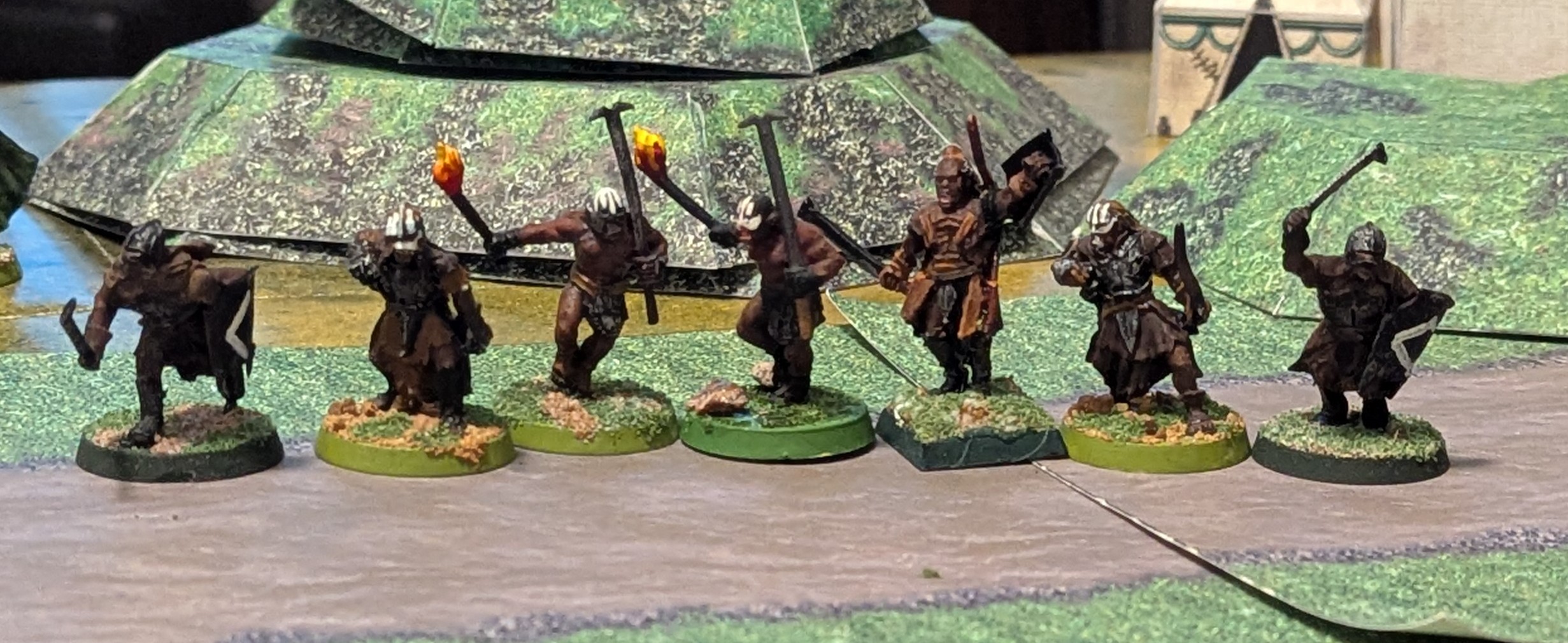 A force of Uruk-Hai are in advance of their army breaking out from the aftermath of The Battle of the Fords of Isen, seeking to establish a watchpost in advance of the main army on its way to Helm’s Deep.
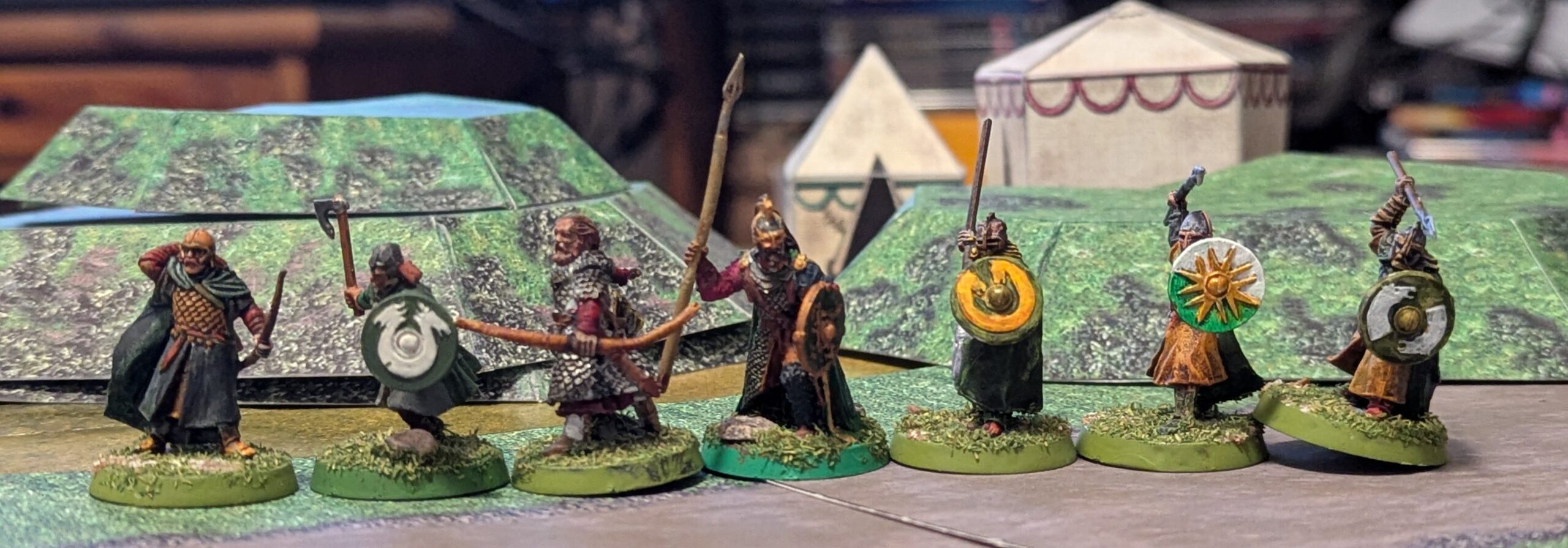 In their way is a small picket force of Rohirrim acting as a rearguard. They are about to strike camp and retire to their next watchpost when they are overtaken. They have to kill the invaders if they hoep to make good their escape.
The Skirmish in play
Both sides took advantage of low mounds that the road is flanked by, so that was some protection against an archery duel being the deciding factor. The clear road, inviting as it was, was avoided at the start, but some fights happened there as they closed in.
The initial turns were short, as the Joker came up far too often. I had decided to reshuffle when both Jokers had been drawn, and, of course, that can lead to them showing up relatively soon, so moves and attacks got interrupted.
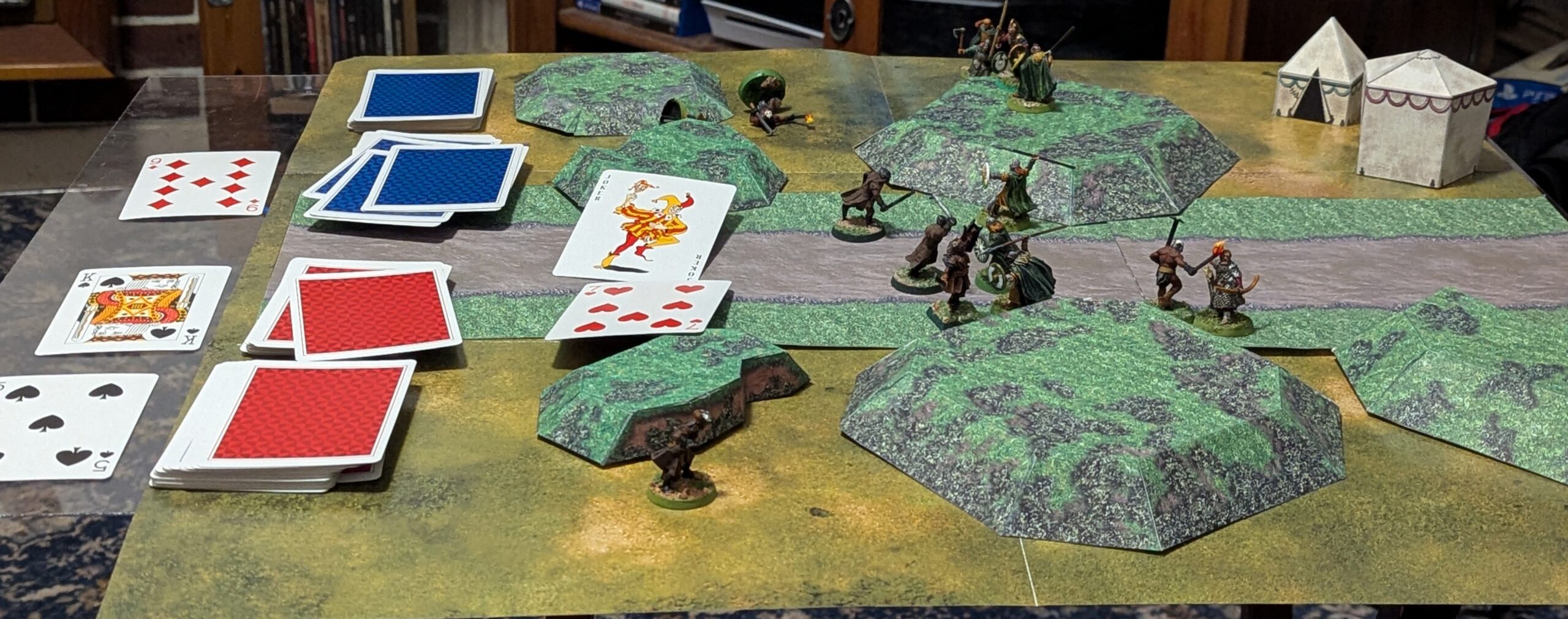
One of the Uruk-Hai Berserkers got wounded a few times, but, in the rules, you have two states, “shocked” (down but not yet out”) and “dead”. To be killed, you have to draw a red card during an end of turn check and the Berserkers’ “Tough” effect makes them vulnerable only on a “Heart”. so they fell over a lot, no armour, but bounced back . I need to give them at least level of armour to reflect them ignoring pain, as they should be hard to stop, but .
Conclusions
These are straightforward rules, with a nicely unified system. The only frustrating things can be
- How frequently the Jokers turn up. They stop everything. If you are resolving a combat, you are about to down the enemy chief, but they draw a Joker, turn ends, resolution time.
- If the cards work that way, you can end up with evenly matched forces hammering away at each other, with attacks having less of a change of getting through a defence. In this game, a Rohirrim warrior drew 1 card for an attack, but the Uruk Berserker drew 3 in the defence, so the defenders often had an advantage.
But that is, literally, the luck of the draw, most of the time the game flows well and gives believeable results. Really looking forward to the fantasy version on 2027.
Open Combat
Front cover of Open Combat
“Open Combat” by Carl Brown is available from Second Thunder Games as hardback and paperback, though I got my copy from Amazon. It uses 6 sided dice, three at a maximum, as attacks are an ATTACK value versus DEFENCE and the ratio determines how many dice you roll. However many that is, you use the highest roll to determine the result, which range from harmful for the target, to potentially inconvenient for the attacker.
The turn is basically IGOUGO, but if the highest number rolled in an attack is a “1”, then initiative passes to the other side, which gives the game a bit more unpredictability. Best make your attacks with the best chance first, lest you blow all your actions for this turn.
Attacks can be physical, prodding with a pointy thing, or psychological, undermining the composure and influeincing the behaviour of an opponent. Physical damage reduces the FORCE of the target, and Intimidate reduces their MIND. Both can be recovered by rest, if they are allowed to, but if FORCE reaches zero, the figure is downed.
Sample profile
| Type | Speed | Attack | Defence | Force | Mind | Renown | Weapons | Abilities |
|---|---|---|---|---|---|---|---|---|
| Gondorian Sergeant | 4 | 4 | 5 | 5 | 3 | 25 | Sword, Shield | Inspire, Shieldbash |
Each army has a Breakpoint, and loss of Force and Mind are totalled and, when they reach the Breakpoint, the army are is demoralised, and flees. If a figure uis killed, then any remaining MIND is added to the total for Breakpoint, so loss of a figure is more devastinging than wounds.
The scenario
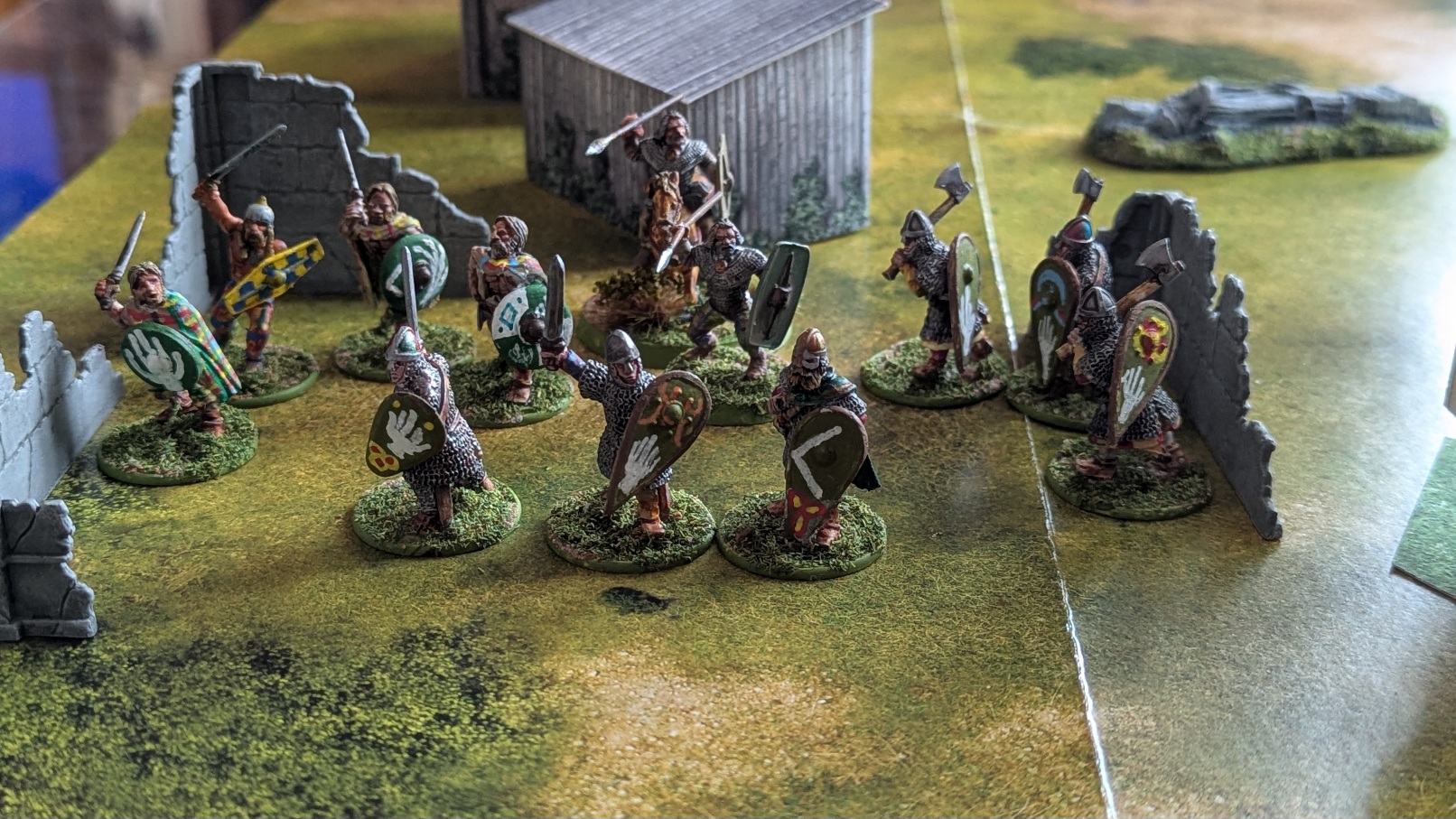 Who can say why Saruman outfitted Dunlendings for a mission to travel round the Western end of the White Mountains to raid Gondor’s provinces. It would serve Sauron more than it would Saruman, but a mix of well-equipped heavy and light troops are closing in on a Gondorian village to bring terror to the masters of their ancient enemies.
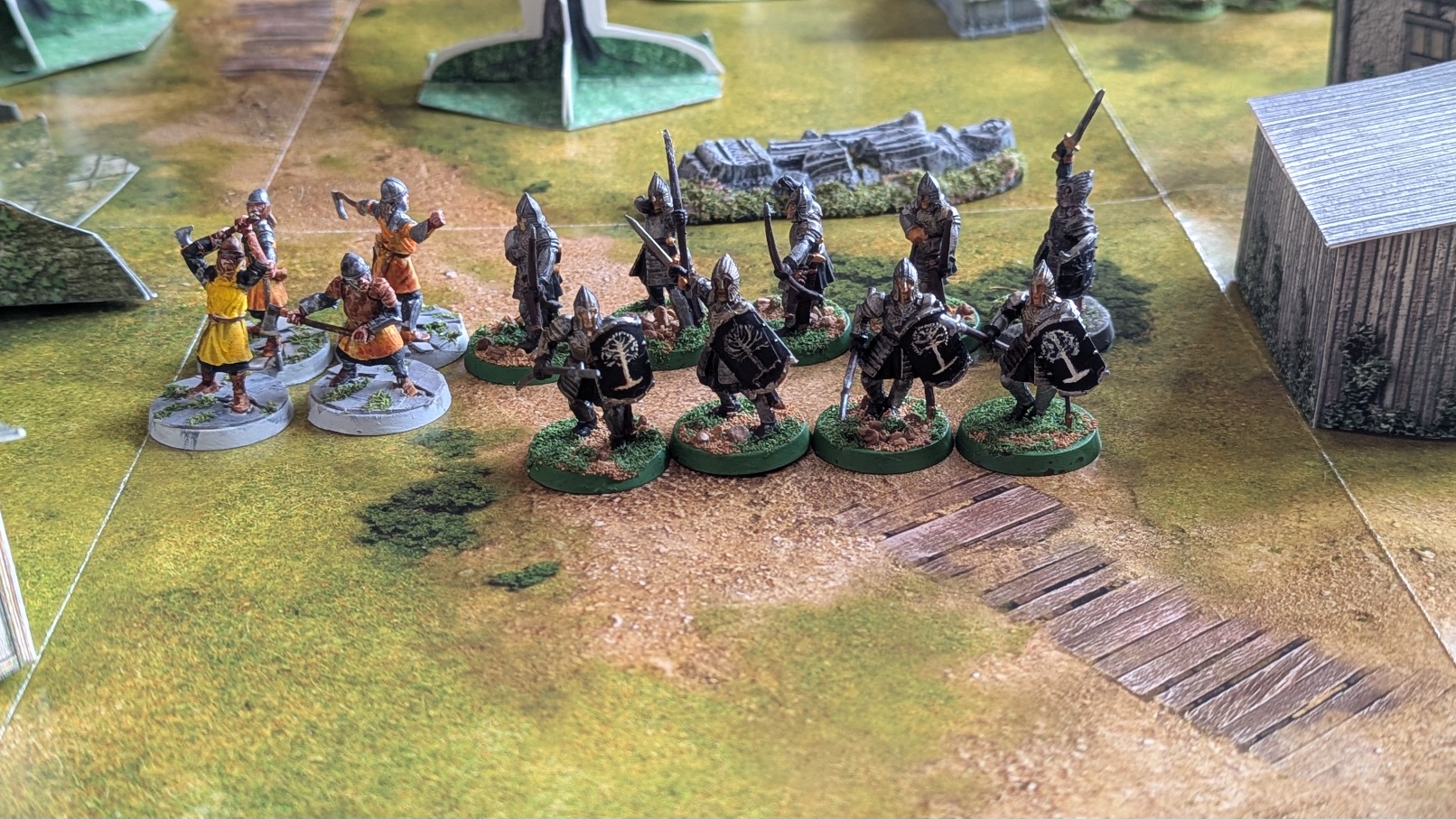 Fortunately the Gondorian villagers have some warning, and a mix of militia and garrison troops are moving to intercept.
The militia are axemen lead by one of their elders, there are two Gondorian sergeants, one leading spearmen, the other leading archers.
The skirmish in play
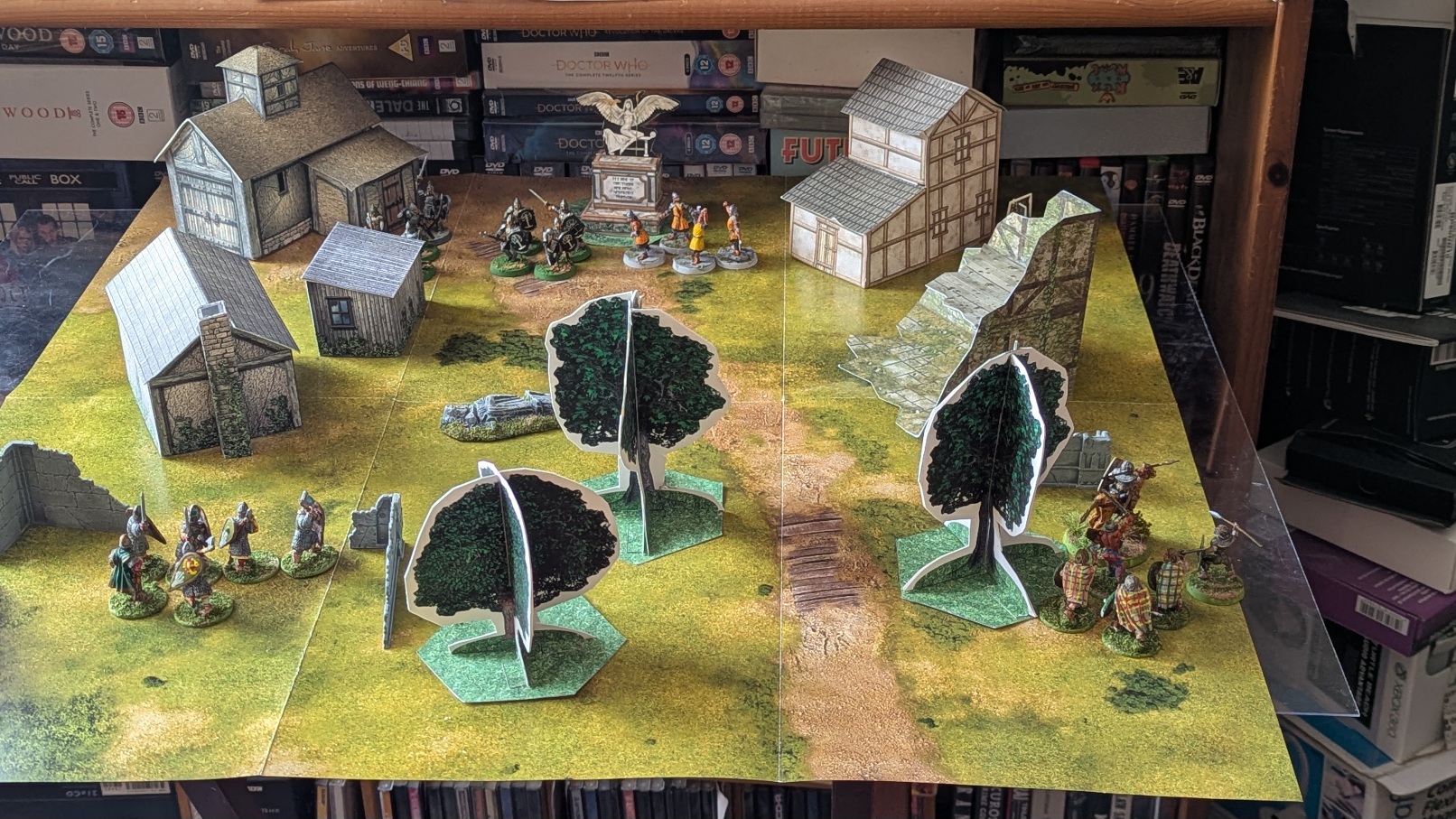 The Gondorians plan to use the buildings and statue in the open square and use them to anchor a defensive line, but the Dunlendings send some of their number up each flank, forcing the defenders to pull back some of their number.
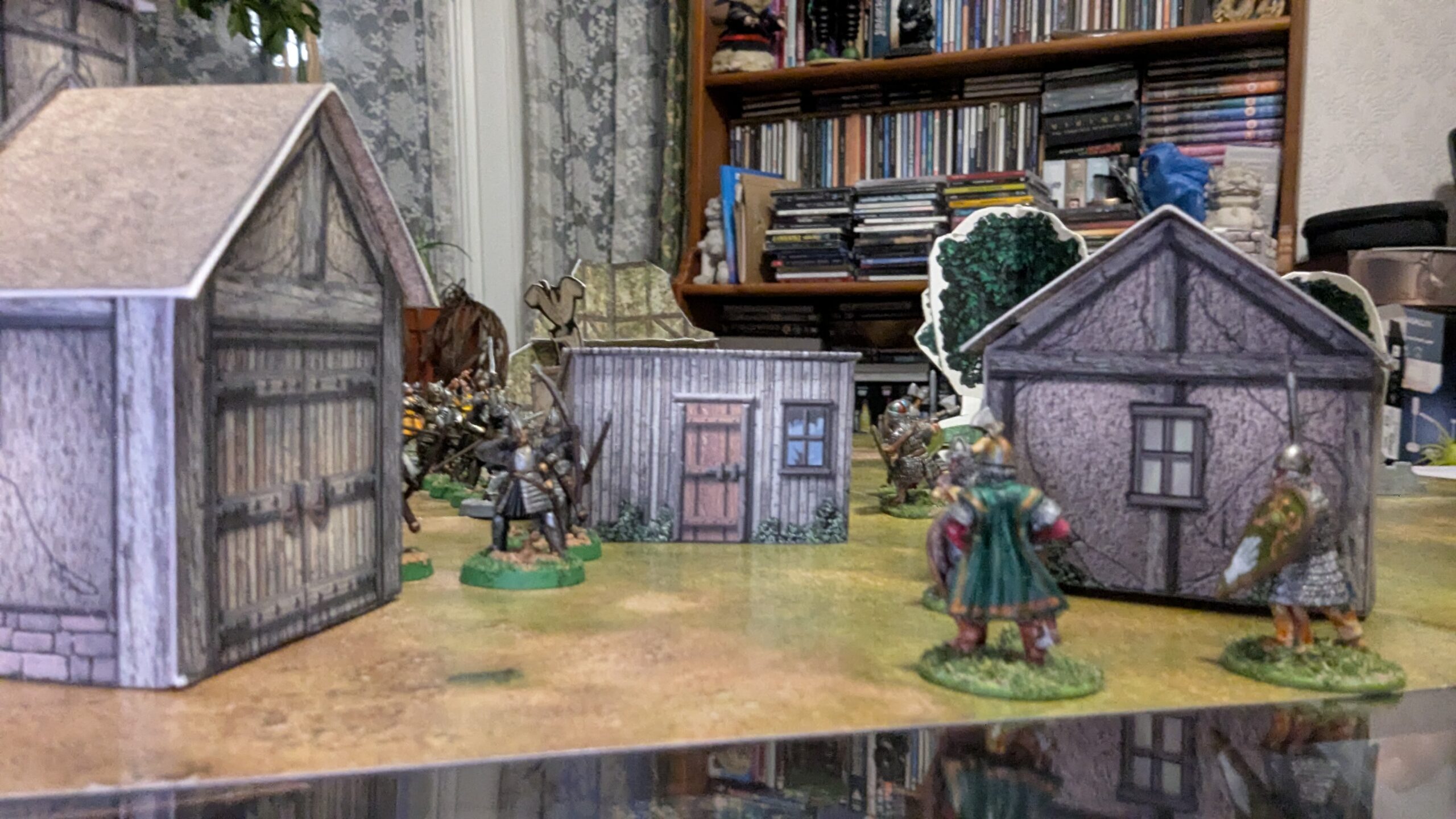 This proved a mistake. The Dunlending chief and two of his bodyguards were attempting to come up their left side, so as to outflank the Gondorians, but massed archery fire forced the chief back off the board, and thus no longer part of the battle.
The Dunlendings close, and the light troops led by a chief on horsebck, and disrupt the militia on the Dunlending’s right flank, and the Gondorian archers on the Dunlendings’ left were losing the fight as the rest of the lines clashed.
The “changing initiative” on some circumstances
As the battle progressed, the Gondorians were suffering more wounds, but these were spread among more of their number, In contrast, the Gondorians concentrated their efforts on a few targets. and, in the end, the fatalities got the Dunlendings to the Breakpoint before the Gondorians.
Conclusion
The rules are not without weird quirks, like there is no description of figuring out the initial initiative, in the main rules. Instead each scenario describes it, but the rule is rhe same as far as I can see. There are no magic rules. In the FAQ it explains that those will be coming later but, in the meantime, use “counts as” for orher weapons, skills and abilities to create magic effects. I do not know when the magic rules will be available.
The only area I would say is tricky to get to grips with is making up your figures. There is no profile design rules in the sense of “heavy armour adds X to DEFENCE and subtract Y from SPEED”. Instead you have to look at the sample profiles and specify them using the most similar profiule as a guide.
However the core of these are easy to pick up, and make sense. You quickly learn to interpret the dice roll results, and how complicating situations are resolved, e.g. forcing back when the target cannot retreat, or attacking from behind, make sense and seem consistent. I enjoyed this and my main complaint was not with these rules, but I was using the wrong sort of tape measure for the sort of feature dense board encouraged by the Terrain section.
I am glad that these were recommended to me, it has a different feel to many rules, in how it handles tricks and taunts as attacks similar to physical attacks. I did not make good use of the psychological attacks, and look forward to exploring that side of the rules more, and applying some of the abilities to the low level magic occasionally encountered in Middle-Earth. Speccing the monsters will be fun!
Overall Conclusion
I only got to play a small amount of each of the three, being short of time before I will be unable to play any wargame for a while, and wanted to make a start. Pillage I cannot judge in full until I am able to get the full rules. I know I like OHAMWS, I have played them before. I am definitekly going to play Open Combat again.
However, more importantly, these games have demonstrated the funb of small foorprint skirmish games, without long sight lines, where up close and personal can have more of an effect, and I think I need to find my files and print more card vegetation and buildings. Especially buildings.
And there are so many other rules to explore. Another time